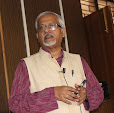
SCRIBES MUST REPORT AS HUMAN BEINGS
Arindam Roy
Varanasi, February 26, 02
SUSAN Koscis, the vice president of Arts and Culture, of the International NGO, Search for Common Ground, quoted a line from a Work War II Musical, “You have got to be taught to hate and to fear,” to explain how conflicts and mistrusts are “Inherited’.
These become ‘educated biases’. The Musical, she explained, was set in South Pacific, describing the ‘torments’ of an American soldier, who fell in love with a girl from that island.
On the second day of her visit, she conducted a two-hour workshop on, ‘Media and Conflict Resolution’, at the Malaviya Centre for Peace Research (MCPR), the BHU, with the aid of video clip-pings. Dr Priyankar Upadhyaya, the convener of the center , had organized this interaction.
Recalling some reports of the Washington Post, she said one day there was a report that Palestinian terrorists had killed innocent people, the Israelis.
Next day, there was a report that Israeli soldiers, in order to protect themselves, had to open fire. Some innocent people, possibly a kid, died.
Thus, while the Palestinians were described as ‘terrorists’, similar acts by the Israeli soldiers were. ‘explainable’ and ‘logical’. The media in the US is liased in favour of Israel. It is not balanced or objective reporting, as it ‘influenced’ the views of the readers.
She said, some of the ‘operative’ words for journalists that help resolve conflicts are accurate, balanced; clarifies and raises consciousness; looks into the fundamental beliefs and issues; encourages diversity and exchange of ideas; provocative but non-judgmental; respects both sides, or as many sides there are, to a conflict, and sees the conflict in its totality.
Ms Koscis said that ’empowerment of people is central to resolving crisis, as it gives them a better understanding of their conflict. It is necessary for those caught in the ‘web of conflict’ to connect with each other as human beings.
She said, “I don’t know who heroes are. But hundreds of journalists in South Africa, the Balkans and Macedonia, on the other side of the conflict, and investigated the real facts, are certainly heroes.
==
SOLVING INTER-CASTE CONFLICTS
Arindam Roy
Varanasi, February 25, 02
MEDIA has an important role to play in solving inter-ethnic conflicts, said Susan Koscis, vice president of arts and culture of the leading international NGO, ‘Search for Common Ground’. She felt that socially conscious film makers help strengthen the influence of film and video in transforming conflicts.
In an exclusive interview to Hindustan Times, she said, the role of the journalists is not to transform the society directly, but to be accurate to provide the readers as much context as they can. They should be careful that the views of both sides in a conflict are presented to the readers.
Koscis said, “Try to be balanced. Journalists cannot be neutral but they should leave ‘bias’, as much as possible, out of the story. It is important to ‘respect’ the conflicting views”.
Talking about how her NGO helped resolve the conflicts between Macedonia and Albania, she said, a 10 day workshop of the journalists of Macedonia and Albania was organized. A prominent lady journalist of the Los Angeles Times, who know both, the languages, conducted this programme. She trained them in investigative journalism, of looking beyond what was being said by an official or a minister. The veracity of their claims had to be ‘tested’, rather than merely reporting their speech. It brought about a change in attitude.
The Macedonian and Albanian journalists teamed up together and explored the facts. New vistas opened up for them. Many of them, with their own initiative continued to do a lot of stories together. They understood each other better. These stories were published in Macedonian and Albanian newspapers. The people too got an Insight into the facts, which helped weed out lot of ‘misgivings’.
Her NGO is working in 10 odd countries. On the first day of her two-day visit to the city, two films were screened on Monday, in the Senate Hall of Swatantra Bhavan at BHU. The first film, ‘Just a Little Red Dot’, is a dramatization of a true story that occurred several years ago in Canada.
It explored the conflict of a young Sri Lankan girl, when she entered the fifth grade. She finds herself alienated in the new environment. Other children tease and taunt her, as she is a newcomer, who cannot speak English and wears a little red dot (Bindi) on her forehead. The film shows how children and their parents revert to prejudice and fear. A conflict is born.
The school teacher helps resolve the conflict. The Sri Lankan girl distributes little red dots to her classmates. Soon it becomes a ‘cool thing’. The situation is transformed. The barriers between the kids break down. She said, though the film made for children. It helped resolve the inter-ethnic conflict for adults, as these children took up the role of educating their elders.
The second film, ‘Long Night’s Journey’ is an award –wining documentary. It depicted South Africa’s struggle to come to terms with its Apart held past. Four stories help raise broader is sues about how the black and the white communities tried to heal their wounds. It is about building a new South Africa from the ruins of hatred.
=
Thursday, February 12, 2009


Wednesday, February 11, 2009
20 lakh take dip at Sangam on Makar Sankranti

A huge rush of devotees had converged at the confluence of Ganga, Yamuna and mythical Saraswati from the wee hours of Tuesday-Wednesday night. The best period of the shnan (bathing) for Makar Sankranti was between 4.30am and 9am.
CJ: Arindam Roy , 14 Jan 2009 Views:296 Comments:0
AS THE sun moved into the summer solstice on Wednesday (Jan 14), 20 lakh pilgrims bathed in Triveni Sangam, on the occasion of Makar Sankranti. No untoward incidents were reported during the second important bathing day of the six-week fair, the annual Magh Mela, according to the district magistrate Rajeev Aggarwal.
A huge rush of devotees had converged at the confluence of Ganga, Yamuna and mythical Saraswati from the wee hours of Tuesday-Wednesday night. The best period of the shnan (bathing) was between 4.30am and 9am, according to Alok Tripathi, a devout who has been bathing in Sangam for last 14 odd years.
The annual Magh (which coincides with the Hindu month), began on Magh Purnima (Jan 11). The arrangements are thorough and foolproof, as it is often likened to a mini Kumbh Mela, said a mela official, talking to merinews.
Pilgrims had started arriving for the Sankranti bathing, at the Mela area, from Tuesday (Jan 13). They came in tractors, bullock carts and trolley rickshaws. Some from nearby places walked slowly. The Sangam area had a colourful look, as people of various age groups rubbed shoulders and walked slowly. While some groups sang kirtans, others raised the cry, ‘Har Har Gangey’, ‘Ganga Mai ki Jai’, as they trudged along to the river banks.
Rekha Devi, a young mother, dragged her two half asleep children, at the Sangam Nose, at 4.30 am. Her son, who was barely eight years old, protested more than his sister. She appeared to be a couple of years elder to him. Rekha had some flowers and change of clothes in a plastic shopping bag. She was not interested in talking. I heard her children’s loud wail, as they were dragged into the Sangam waters. Soon, a wave of pilgrims arrived and I lost Rekha and her two children in the maddening crowd.
An old couple, in their eighties, was walking slowly to the river, aided by their sons and grandsons. The entire family was deeply concerned about the elders. They were asking the impossible crowd to give them a little way.
When the crowd parted, it seemed no less a miracle than the parting of the sea by Moses. All this was seen at about 6 am, the same day. A poor, childless widow, Suggi, in her seventies, told me that she had saved a fistful of grains from her daily meals, for years. The small savings that she generated, each day, year after year, helped her attend the fair this year.
It is interesting to see a temporary township spring up. It’s made of bamboo, tins and tents. Rows of shops and wayside vendors lend to the colour and mood of this vibrant fair, which is as old as Vedas, said Rahul Pandey, a Sanskrit scholar.
The entire Mela area has been subdivided into several sectors, with a sector magistrate looking after each sector. The district magistrate Aggarwal, who is also the Mela Adhikari, is heading the team of meal officials.
By Wednesday evening, the administration heaved a sigh of relief, as there were unconfirmed reports of a possible terrorist attack, according to a section of the media.
( http://www.merinews.com/catFull.jsp?articleID=156293 )
Integrate social studies with science: Justice Katju

The social program must form an essential part of the concept of Science Conclave, as it offered numerous opportunities for encounters and dialogue between young researchers and Nobel laureates, said Justice Markandey Katju at IIIT-A.
CJ: Arindam Roy, 22 Dec 2008 Views: 1086 Comments: 1
IT WAS final curtains for Asia’s first Science Conclave organised at Indian Institute of Information Technology – Allahabad (IIIT-A), on Sunday (Dec 22), at the Jhalwa campus, with a happy note.
Supreme Court judge, Justice Markandey Katju, speaking as the chief guest at the valedictory session held in the pandal asked the scientists to pay their equal attention towards social science for all-round development of the society.
Illustrating the things in depth, he successfully elaborated all the aspects of economics in collaboration with science to the students. He sought integration of social studies with science. “The social program must form an essential part of the concept of Science Conclave because it offered numerous opportunities for encounters and dialogue between young researchers and Nobel laureates and also between the young scientists themselves,” he said.
Elaborating the worldwide market recession, Justice Katju said if we fail to solve this crisis then despite having good science degrees, students remain out of jobs. Therefore, he urged the scientific fraternity to think over this critical aspect and then develop most appropriate technology in the country.
He suggested that scientists to help in making product strong and cost effective. He called upon the scientists to join hands in overcoming from the economic recession.
He asked the science students to give equal emphasis on reading economics, social science and other books, so that it may help in broadening of their thought process. This spectrum of thinking will increase resulting in the opening of new scientific thinking towards the challenging aspects of economic recession.
Elucidating the concept of Science Conclave, the IIIT-A director Dr MD Tiwari said that it was in the wake of promoting the scientific temperament and invigorating the studies and researches of sciences after the World War II that successful efforts were made at Lindau, Germany where since 1951, meetings of Nobel laureates had been continually held by the Council for Lindau Nobel Laureate meetings and Foundation Lindau Nobel Prize winners meetings at Lake Constance.
“In every meeting, about 20-30 Nobel laureates participate and some 500-700 students and young researchers come from all over the world to listen to the laureates' lectures and engage in discussions with them in an open and informal setting. Representatives of universities and academic institutions select participants based on strict criteria provided by the Council”.
Dr Tiwari further said that IIIT-A Science Conclave provided all participants with exceptional opportunities to take part in valuable scientific and personal contacts, cutting across national and cultural boundaries. The concept of bringing together Nobel laureates and students / young scientists in a relaxed and informal atmosphere remained the key denominator for the success of the meetings.
These unique events also attracted regularly many representatives of the media and their reports encouraged a dialogue between science and society. All contributed to a general understanding of science, a demand of increasing importance to the society. This meet provided a globally recognised forum for exchange of knowledge between Nobel laureates and young researchers.
In the morning session Dr. D.N. Talwar head of the department of Physics, Indiana University, Pensivliyana, US, addressed the students. He talked about nanotechnology and its implementations in daily life and technology. He illustrated the things by examples of Cathedral in Paris, Blue Mosque in Istanbul and strongest sword. He told how in the ancient time also this technology was in existence. That is how they were able to make coloured glasses, which never faded with passing time, even six centuries.
Talking about the strongest sword, he said that it was made of wootz steel, the composition of which we have come to know recently. All the colour effect he said were because of plasmonic effect and a new emerging field of science is coming up called nanophotonics.
Prof M Radhakrishna organising committee member informed as many as 1113 students comprising 984 students (659 male, 295 female), 146 teachers (122 male and 24 female) took part in the Science Conclave.
The PRO Pankaj Mishra’s initiative helped in wide coverage of the event in print, TV and the only online media, merinews.com.
The cultural evening saw Shovana Narayan present her vivid classical, dance while main attraction of the Saturday evening were noted Gazal singer duet Bhupendra and Mitali. They enthralled the audience rendering melodious gazals and Hindi film songs. It was their first visit to the city. They promised to come again, in the Sangam city, where knowledge, myth and history confluence.
(http://www.merinews.com/catFull.jsp?articleID=154214 )
Daksha Sheth expresses the agony and ecstasy of dance

Daksha Sheth’s dance tells you that she has broken barriers to release her supreme artistic creativity. Dance is her catharsis, her agony and ultimate ecstasy. Her fluid movements and effortless grace holds you spellbound.
CJ: Arindam Roy, 20 Dec 2008 Views:1319 Comments:0
DAKSHA SHETH, a prominent danseuse and choreographer in India enthralled the Science Conclave participants presenting fusion of western and Indian music at Indian Institute of Information Technology-Allahabad (IIIT-A), on Thursday (Dec 18) evening.
The gutsy and dynamic dancer Daksha started her career with traditional dance. During 18 years, she was a traditional dancer and as such she was making a living and doing well. But she wanted to switch over to contemporary dance - and worked hard for many years to make a breakthrough in this field.
Daksha’s dance tells you that she has broken barriers to release her supreme artistic creativity. Dance is her catharsis, her agony and ultimate ecstasy. Her fluid movements and effortless grace holds you spellbound.
She presented various compositions at IIIT-A. She began with Ganesh Vandana (the text is from the Sama Veda). The music was composed by Devissaro.
The main elements of Daksha’s dance performances are a blend of the traditional with the modern. She gives expressions to her artistic talent, gaining the liberty of free verse in her dance forms.
Though she has retained elements from the traditional dance forms, she amalgamated it with modern music, clothes and movements in an interesting way.
Daksha adapts electric guitar music to the old Kathak footwork, complete with ankle bells and gracious arm movements. She combines classical Indian martial arts, yoga, Kathak and Chhau dance techniques.
Daksha - famous as one of India´s most prominent dancers - has a dance studio in New Delhi, which symbolises for the modern Indian dance what Merce Cunningham is for modern dance in the western world. Here, traditional techniques are given new energy and new expressions in a way which attracts best dancers from around the country.
She is one of the most sought-after teachers in both classical forms and new Indian dance.
Her dance company has won international acclaim for its dance-theatre production that brings together performing artistes from many disciplines drawing on the wealth of their traditions.
( http://www.merinews.com/catFull.jsp?articleID=154090 )
Adopt technology to dispose pending cases: SC judge

Justice PP Naolekar of the Apex Court asked Nobel scientists at IIIT-A to devise such technology that can help in disposal of legal cases in the Indian courts. It was essential to adopt suitable technology for streamlining pending cases.
CJ: Arindam Roy , 20 Dec 2008 Views:1816 Comments:0
SUPREME COURT Justice PP Naolekar has asked scientists to devise such technology that can help in disposal of legal cases in the Indian courts.
Addressing at the Science Conclave at Indian Institute of Information Technology-Allahabad (IIIT-A), Justice Naolekar on Saturday (Dec 20) said that 30 years ago only 20- 30 cases had to be witnessed lying pending before the courts but now several cases were in queue to be finally disposed off in Indian courts. Therefore, he urged the science fraternity to develop a technology in order to expedite the pending court cases.
Owing the welfare of the citizens of the country as main concern of the judiciary, it was essential to adopt suitable technology for streamlining pending cases.
He said application of mind was essential requirement in delivery of judgment considering the complication of facts and witnesses. Justice Naolekar lauded the initiative taken by IIIT-A to promote the basic science and research in India through organising this Nobel scientists’ congregation.
In his welcome speech Dr M D Tiwari, IIIT-A director said that technologies, whatever aspect they are concerned with, are dependent on scientific methods and methodologies. Newer and newer scientific researches, sharpen, update and advance technologies. The world today is highly competitive and technologies, if not updated and upgraded, fall sick and are rendered off-beat and un-competitive. So there is constant scope for upgradation of technologies that is possible only with the held of latest scientific researches. He presented Science Conclave momento to Justice Naolekar.
Later, students and teachers had marathon informal discussions with Nobel scientists over tea in the pandal.
( http://www.merinews.com/catFull.jsp?articleID=154089 )
Subscribe to:
Posts (Atom)


 Posts
Posts